


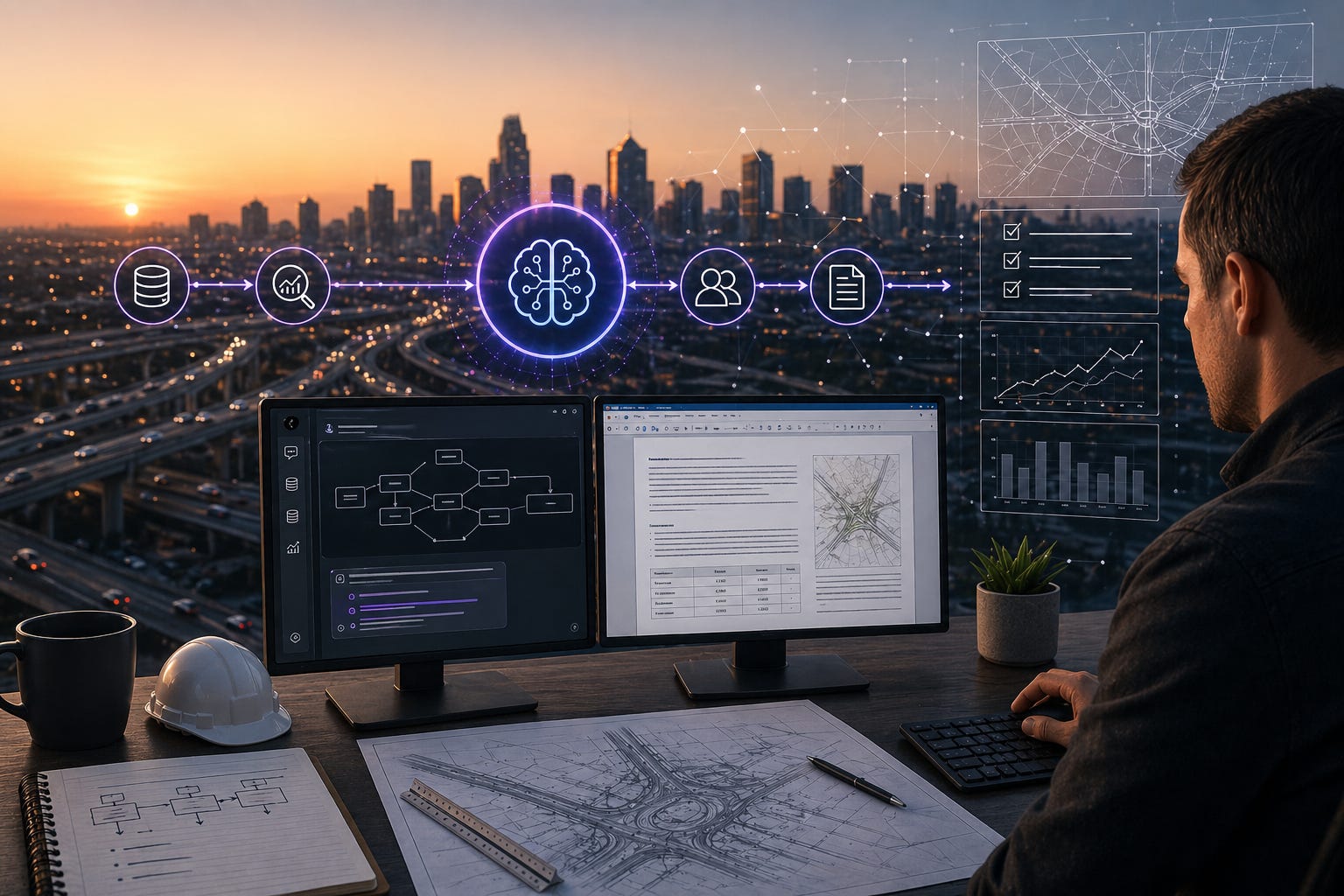
Over the past few months, I’ve found myself reflecting more deeply on where artificial intelligence (AI) is actually heading in transportation engineering and in engineering practice more broadly. This is the culmination of discussions with clients, developing tools with vendors, networking with peers, and contributing to ITE’s Great Idea Group in AI.
There’s a noticeable shift underway.
We’re shifting out of the early curiosity phase, where AI was something to experiment with, and into a more active discovery phase, where people are starting to test how it fits into day-to-day work.
We’re not at a mature end state. Far from it. However, we’re no longer at the beginning anymore.
Resetting Expectations
Much of the current conversation around AI still swings between hype and dismissal. In practice, the reality of AI likely lies somewhere in between.
Across engineering, most use remains relatively surface-level: drafting emails, summarizing documents, answering quick questions. These use cases are helpful, but can be limited in engineering-focused applications.
At the same time, a smaller but growing group is pushing further and trying to integrate AI into actual workflows. That means connecting it to data, documents, and structured processes rather than treating it as a standalone tool.
The gap that’s emerging is not simply between “users” and “non-users”. It’s between shallow use and integrated use.
That distinction is becoming increasingly important.
Further, this aligns with what I’ve previously described as the “missing middle” of AI productivity, or the gap between basic usage and meaningful integration into real workflows.
From Tasks to Workflows
The most meaningful shift is that AI is beginning to participate directly in workflows, rather than simply answering questions.
Instead of isolated prompts, we’re seeing early forms of what could be described as a “sidecar” model where AI is embedded alongside existing tools such as Word, Excel, and other analysis environments. In these contexts, AI can assist with drafting, structuring, and iterating on work while being connected to relevant inputs.
Examples are starting to emerge:
Drafting first-pass technical reports;
Reviewing and suggesting edits to structured documents such as contracts;
Pulling together information from multiple sources; and
Supporting analytical workflows alongside conventional engineering tools.
This is also where the idea of AI as a virtual “team member” starts to take shape. This goes back to the human-in-the-loop (HITL) concept, where AI becomes a participant in the process, but this does not replace humans for engineering judgment.
One pattern is becoming increasingly clear: AI helps solve the blank page problem. Whereas engineers, in turn, operate in a critique and refinement mode.
The narrative is not that “AI replaces engineers”, but is instead “AI generates, engineers refine”.
That shift is subtle, but it has implications for how work is structured, how time is spent, and how teams collaborate.
At the same time, it’s important to recognize that this transition will not be seamless, and adoption will be uneven. Some professionals will embrace these tools quickly, while others will remain cautious or skeptical. This is understandable, and very human!
We’ve seen similar patterns before. When CAD replaced manual drafting, or when spreadsheets displaced ledger books, there was resistance. Over time, those transitions became standard practice.
AI is likely to follow a similar trajectory.
Why Engineering Is a Hard Case
Engineering is not a simple environment for AI to operate in because it is a regulated profession, grounded in public safety, accountability, and professional responsibility. Work is often multi-layered, combining data, context, modelling, and documentation, all within specific regulatory and jurisdictional frameworks.
This creates a natural constraint on how quickly AI can be adopted.
Unlike more loosely structured domains, engineering requires a high degree of confidence in outputs. Data must be validated. Assumptions must be transparent. Decisions must be defensible.
AI systems still struggle in these areas, particularly when context is incomplete or when validation is required.
For that reason, full automation is not imminent. Human oversight will remain essential.
At the same time, the presence of regulation should not be mistaken for insulation. It may slow adoption, but it will not prevent change.
Engineering is likely to experience a more gradual but still meaningful transformation as these tools improve and workflows evolve.
Early Signals on Economics
While the technology is still maturing, early signals are beginning to appear in how work may be valued.
Lower-complexity deliverables, particularly those that are repetitive or highly standardized, are likely to be affected first. First drafts, structured reports, and routine documentation are already becoming faster to produce.
In transportation engineering, a common example is the Transportation Impact Assessment (TIA). These types of studies form a significant portion of routine consulting work. As AI-assisted workflows improve, it is reasonable to expect that the cost and time associated with producing these deliverables may begin to compress.
If that occurs, it may serve as an early indicator of broader economic change in the industry.
This does not imply that work disappears. Rather, the value of different types of work may shift.
Consultants may find themselves either leveraging these tools to increase throughput or needing to differentiate based on higher-value services that rely more heavily on interpretation, judgment, and expertise.
While clients may not yet be asking how AI affects cost, as these tools become more embedded in workflows, that question will inevitably surface. In transportation engineering, typical TIA reports may represent a “canary in the coal mine” moment, but other engineering practices will likely see similar inflection points.
What This Means Right Now
At this stage, the most practical response is not to overhaul existing processes, but to begin engaging more deliberately.
For individuals, that means moving beyond surface-level AI use and starting to experiment with how AI fits into actual workflows. Where does it help? Where does it fail? Where does it introduce risk?
For teams, the immediate task is observation rather than transformation. Understanding how work is being done, and how it might evolve, is more important than attempting to redesign structures prematurely.
There is still a great deal of uncertainty. But there is also a growing need to build familiarity and capability.
Where This Is Headed
Looking ahead, the direction is becoming clearer in that workflows will continue to evolve, tools will improve, and integration will matter more than individual features.
The competitive advantage will come from structuring how AI is used, how it connects to data, how it supports decision-making, and how it is governed within professional practice.
This transition will happen gradually over the next several years and is likely to become a defining aspect of engineering work.
Final Thoughts
AI is beginning to shift from a tool we use occasionally to something that participates directly in how engineering work gets done. As these workflows evolve, the opportunity is to rethink how engineering work is structured, reviewed, and delivered.
However, AI adoption in engineering will hinge on trust - both in the tools themselves and in how they are applied. That means validation, transparency, and professional accountability will remain central as these systems become more embedded in practice.
So the next time you sit down to draft a report, review a model, or analyze a dataset, consider how AI might participate in that process.
Questions to Consider
Where in your current workflow could AI realistically support or accelerate your work today?
What aspects of your work still require human judgment that cannot be delegated?
As workflows evolve, how will you define and demonstrate value in your role?